Leaderboard
-
Toro
Administrator8Points1,711Posts -
Jughead
Supreme User5Points643Posts -
Gravedigger
Supreme User4Points932Posts -
panchbarnes
Supreme User4Points495Posts



Popular Content
Showing content with the highest reputation on 03/23/2014 in all areas
-
8 pointsHire a passed over Major who doesn't give a shit and will tell you what he and everybody else thinks straight to your face.8 points
-
They also take our cyber awareness CBT...through our networks.4 points
-
4 points
-
2 pointsI'll offer a few points, in no particular order: A leader's job is to Direct, Unite, Inspire, and Support. If you're doing anything that's not in those categories - stop doing it! Be the Group Commander, not a Super Squadron Commander. In the MSG, for example, it's common for the MSG/CC to try to be the super-SFS/CC or super-BCE or whatever careerfield he came out of - over-managing that squadron while giving the other squadrons in the group too little direction. Don't do that. Ever. Seriously. You probably didn't like it when you were a sq/cc, so don't do it to your people. Be willing to tell the wing commander "I don't know, but I'll find out." We have an MSG commander who is simply the biggest control freak and data hog I've ever met. His squadron commanders literally spend 30-50% of their work week managing HIM instead of doing their jobs. He creates the very chaos and inefficiency he professes to try to cure. This is driven by, I think, 2 things, which a good group commander will avoid: 1. He needs an enormous volume of information before he feels like he understands an issue or activity. No matter how much you try to provide the answers up front, he'll still come back at you with more questions. Providing more detail to allay his insatiable need for info merely provides more avenues for enhanced questioning. 2. He's afraid to be caught not having the answer to every question he might ever be asked. As a group commander, you've got to know what's generally going on in your squadrons and the rest of the wing, but you're not paid to know everything in detail or do your squadron commanders' jobs for them. If you don't know, man-up and admit it. And also give yourself a break because it's neither feasible nor reasonable for anyone to expect you to know everything. As a general rule of thumb, think about the things that provide job satisfaction for you in a leadership position - having authority, being held responsible, encouraging and facilitating teamwork, solving complicated problems, developing the people under you to help them grow professionally and personally, etc. Then make sure you do nothing that deprives your subordinates of enjoying that same job satisfaction.2 points
-
2 pointsI attended the Hoover Gala last month in LA. You are absolutely correct. https://hooverhallofhonor.com/hall-of-honor/ And you can include Col Bud Anderson. Great American.2 points
-
2 points
-
We must not allow a CBT gap!1 point
-
Bunch of f**king clowns. Any flag worth his stars would unilaterally shut this migration down until later this year.1 point
-
1 pointYou're right, I should have clarified. It was this kind: Sent from my iPhone using Tapatalk1 point
-
1 point
-
1 point
-
1 pointMy favorite CZ story was he got pissed at Salem, when he was a Sq/CC, that people were selling their issued equipment on the base's "for sale" use group on Outlook. So he sends out this long worded email about how that's illegal, etc. Some FE hits reply all from CZ's and says he has a Camelback for sale in his room. He ended up with an LOR or something but everyone laughed and gave him props.1 point
-
1 pointWait...what kind of "Dude" was that...was it an excited "Dude, you play too?!?" or a "Dude, want to play?" or a disappointed "Dude, did you really post that?"1 point
-
SECAF came to our deployed location yesterday and I was able to attend a brief talk she gave. There were three interesting tidbits that at least I hadn't heard before: 1. In regards to force shaping: "We did a poor job of communicating with you." That's pretty close to a direct quote and she said it two or three times. I think that constitutes an apology for poor performance and obviously means A1 and AFPC are under the gun. 2. There will be 2 RIF boards now, but if you're eligible for the first you won't be eligible for the second. There was a lot of double speaking surrounding why they went to two boards and no details about who will be eligible for the first and who will be eligible for the second. She did say that if there were discipline issues between board 1 and 2 you could end up eligible for both. Sorry if that one is redundant news, but it certainly hadn't filtered its way out here. 3. Pay raises below the employment cost index are merely slowing the growth of pay. They're not a cut in pay... definitely not a cut in pay... trust me... that's an order.1 point
-
1 point
-
1 pointFunny moment from SOS with the Commandant-in-question: It was Day 1 or 2 of the course and he was giving his intro speech. He said words to the effect of "Take a look around, for 80% of you this will be your last in-residence PME experience" Next to me was a SpecOps pilot who was silently shaking and pulling his fist in celebration... I don't think our esteemed leader thought his words would have that effect.1 point
-
1 pointShe has me a little excited... I'm going to change my name to Noonan and see if she wants a sidekick.1 point
-
1 pointMeh.... M-word outdoes that in the first 3 minutes of any speech or interview....1 point
-
1 pointYeah, so was ours, now that I think about it, because I think that is how the reg was written that leave begins and ends in the local area. Everyone still ended their tours at home. I think the idiocracy of guys from the unit potentially having to drive from as far as 8 hours away to get back to base to end their leave, only to turn around and drive 8 hours back home was actually overshadowed by practicality. Can you see the reg watcher shoe clerk's face when, after driving 8 hours to "end your leave in the local area," you ask for another manday to drive back home, along with the accrued leave that said manday would incur, because you drove more than 400 miles and are entitled to another day according to JFTR para U3005???1 point
-
Since vsp has been delayed my tertiary plan to get out moved forward. Win a billion dollars from Warren buffet and establish a conflict of interest. Unfortunately I underestimated Dayton's skills and was out after the first game. It's up to you now AFPC. Though I think my odds were better to win the billion.1 point
-
It is sadly unsurprising that the official responses continue to avoid answering the relevant questions. The questions among officers primarily deals with those who were listed as overages on the January RIF matrix. Since AFPC has pulled that matrix, rather than updating it, it leaves many of us puzzled: Am I in an overage AFSC/yeargroup? I was in January, but now I'm unsure. When will this information be released? If 50% of applicants are ineligible, then what's the holdup on the other 5,000 applications? The January 23 voluntary matrix is still posted on the MyPers website. Were the "ineligible" applicants in blue rectangles or red ones? AFPC could save itself a lot of wasted effort by producing clear and timely guidance and by updating, rather than subversively removing, the previously released guidance. With all the flail around these programs, you would expect some changes to the Voluntary Matrix and the RIF matrix. It's been two months....1 point
-
Show-horses, Workhorses and Jackasses. These are the three types of people you have working for you. Show-horses are easy to identify, they are pedigreed, their reports are above the board and they have done no wrong, but at a certain point you can’t prove what they have done right… they have been preened and primped for so long that the next good deal is expected. In a certain amount of your requests to the squadrons for nominations for the next good deal job, there are some that will deliver less than the workhorse. They are the type when handed a shitty deal, will pull stakes and tell you no, because this assignment is beneath me…. The workhorse is the person you want to take note of. This person may be number 3 or 4 on your squadron commander’s list of people they want to see for said good opportunity. They are probably the guys and gals that everyone in the squadrons see as the go-to for when stuff needs to get done, the people that get overlooked because there are a couple show-horses in the way. The often respected and narrowly rewarded workhorse getting rewarded with a good deal usually elicits the following response from squadron mates: “about damn time that guy/gal got a good deal he/she is solid and I know they will work for me up at the Group/Wing etc.” The response when an overtired prima-dona show horse gets an impressive job is usually de-motivating. Seen as a reaffirmation of the status quo. Thus, as a group commander the people who are at the top are there because of past performance but not necessarily recent performance… The challenge is to identify the workhorses who deserve a showhorse treatment and identify the showhorses who need a kick in the ass. Speaking of asses, the jack-ass… causing the often mentioned 95% percent of your time devoted to the 5% causing the problems. It will distract you because you think the other guys, the other 5% who are the show-horses are solving all the problems are good… and carrying your load… it’s not true, at least at the squadron level…1 point
-
1 pointNo, but I bet a guy looking through smudged safety glasses with sawdust and the mid-day sun in his eyes probably does. Honestly are you debating if the tattoo looks like a real gun or not? What psychological depth perception cue tells you the difference between a 2D image and a 3D object that's only about an inch thick from 20 yards away? Answer, none. I'm not saying the guy was doing anything outside his rights or that the cops reaction was necessary. I'm saying a stupid decision was made and he got a stupid consequence.1 point
-
1 point
-
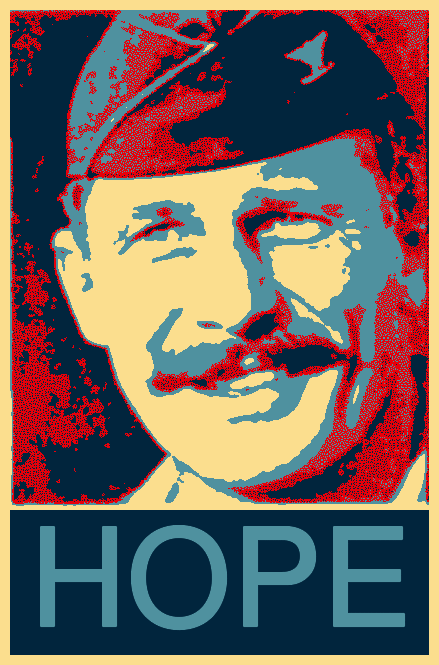
1 pointI'll second the "why are people complaining" line of thought. Do you haters actually think Gen Welsh is trying to fool anyone with MM? He's trying to make the best of a bad situation. If you can't have a little fun now and again, you're way too uptight. I don't think the AF was fixed overnight, and things are still pretty dismal, but now I don't have to wear blues on Monday, and my mustache is going to be wildly out of regs. Will either of those things affect a potential decision to get out? Nope.1 point
-
1 point
-
1 point1 point1 pointNot directing this at anyone in particular, as I am guilty of this as well, but Gen Welsh has actually made moves to increase morale in spite of the Air Force's dismal outlook (budgets/force shaping, etc.) Yeah things aren't perfect and we got a long way to go, but thank God Skeletor II is done destroying our Air Force and we got someone who seems to genuinely care.1 point1 pointMandatory Mustache March for all MAJCOM commanders - From the Air Force Association Facebook page:1 point1 pointI can't believe people are even considering this. Being born American is like winning the lottery, have some pride and loyalty and get behind the Stars and Stripes. We will never be perfect but we are still the city on a hill.1 point1 pointYou know, given all the other shit we have to deal with "more with less" sequester etc a gesture from ole CSAF of suspending that particular section of the reg 1 Mar - 31 Mar would go a long way.1 point-1 pointsThe weather must be pretty nice up there on your high horse with your rose-colored glasses. I suppose being an informed voter, a good parent, a regular volunteer, and a tax payer doesn't qualify me to have an opinion about where and how I want to live my life after I give 20+ years of service to a branch of the armed forces. Sent from my HTC One X+ using Tapatalk-1 points-1 pointsLooking for anyone who may be joining me at Sheppard for ENJJPT this July. I'm not sure our class number...but looks like graduation is slated for Aug 2015.
 -1 points