
Leaderboard
-
VMFA187
Supreme User8Points780Posts -
brabus
Supreme User5Points4,766Posts -
Runr6730
Registered User4Points139Posts -
DirkDiggler
Supreme User4Points1,009Posts




Popular Content
Showing content with the highest reputation on 05/10/2023 in all areas
-
7 pointsIf a woman (or man) is proven to falsely accuse someone of rape, she (or he) should face the same sentence that the "accused" would have faced if proven guilty.7 points
-
Don’t do it. You’ll have to get your own ATIS4 points
-
3 points
-
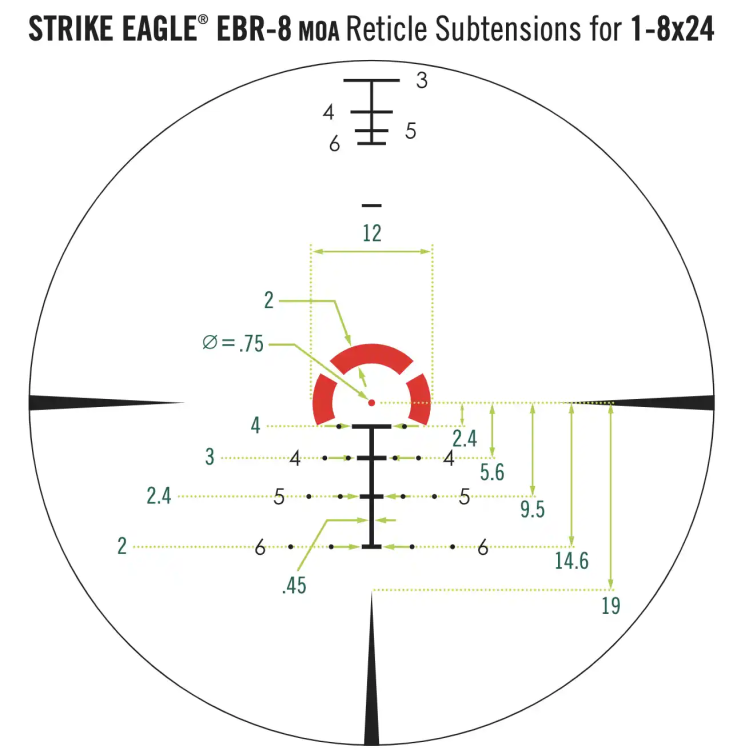
2 pointsI just put a Vortex Strike Eagle 1-8x24mm LPVO on a AR-15, PSA had a great deal on them the weekend before last, $355 delivered with mount! It has BDC references to 600 yards for standard .223/.308 loads... Outdoor Life crowned it the best LPVO for 2023! https://www.outdoorlife.com/gear/best-lpvo/

 2 points
 -
2 pointsLook at LPVOs…1-4x is sufficient, but 1-6x is probably worth it, even if you think you’ll never shoot beyond 300 yds. But to Lawman’s point, if you are “confident” you’re not going to use this inside 75 yds or so, then a fixed power scope is a great idea (can easily install offset sights for closer work later).2 points
-
1 pointI’d looked at those this past weekend, they got really good reviews. Thanks for the recommendation/data.1 point
-
1 point@Negatory Really helping your credibility here. Feel free to peruse multiple years of discussion where you were wrong, many people were right, you were a self-righteous asshole to them, then you gave a “sorry (but not really sorry)” apology after it became impossible to hide the fact you were wrong…and now you’ve decided to quadruple down by arguing why it’s OK you were wrong and being a douchebag to others was warranted. It must be painful as fuck to be your IPs/WOs dealing with all the quibbling and excuses you must make.1 point
-
1 point
-
1 pointI was going to ask the same thing but it's kinda not worth engaging. Claiming it provides "zero protection" while being "very harmful" based on a number "he heard" is the kind of quality, evidence-based reasoning that lets me know it's probably time to put the phone down for the night. Funny part is my point has never been about the jab itself. It's always been about having the awareness to know what you signed up for and go in eyes wide open. I'm a big believer in worrying about the biggest and closest alligators to the boat, which, in terms of service member health risks, are: 1) long term ailments from on-the-job hazards we've completed normalized 2) dying in some interventionist boondoggle halfway round the world ... ... ... ... 67) drowning in Tumon bay 68) actual alligators 69) covid vaccine side effects Which is why this whole outrage seems a little manufactured, out of proportion, and strangely coincident with a red-to-blue presidential admin turnover.1 point
-
1 pointIf you’re going with that “short” a distance, I’d go with either a combination standard red dot and magnifier, or leaning more toward not going in houses just a standard 4x optic. I’m a big fan of Aimpoint and magnifier combos. Little heavier but does either job well, just practice transitioning. Sent from my iPhone using Tapatalk1 point
-
1 pointOh yeah, I’m positive she doesn’t. I still think he should sue her for millions on principle, and get whatever she/her family can give according to the court. They deserve to lose their asses on this. The parents are culpable having obviously done a shitty job of raising their kid. I have a feeling you had a membership card there at one point…remember the midget!?1 point
-
1 pointI rarely support lawsuits, but I hope this guy sues this girl/her family for 10s of millions…loss of wages, career earnings potential, defamation, etc.1 point
-
1 pointAre you talking about 1stLt and Capts in a Marine fighter squadron?1 point
-
Speaking from the tanker side yes. That’s what they are there for. Of course the budget fluctuates but by enlarge they want young mobility guys doing mobility stuff. Sent from my iPhone using Tapatalk1 point
-
Or, depending on the type of orders you are on, maybe you wont go because the funding stream won’t allow it, mission requirements, etc For example, if you are on MPA for a MAJCOM or specific mission you may not be able to go on the trip you want to go on because you have to stay behind and support the trip, alert or mission that they are funding you for. So like Lockjaw said it depends Sent from my iPhone using Tapatalk1 point
-
1 pointIt's a shame our military compensation system creates an incentive for young enlisted folks to get married as soon as the possibly can. Live in a dorm room with drug sweeps at 3am, some asshole reving his Charger in the parking lot at midnight, and leadership randomly dropping by to see if you've dusted and mopped...all while sharing a bathroom with a kid who plays WoW 16 hours a day and has pizza boxes stacked to the ceiling (a ceiling covered in black mold, BTW)...or get married and move into an apartment off-base, away from your leadership's invasive inspections and your retarded dorm mate's behavior?1 point
-
1 pointGood read (yes it’s NYT…Still, very well written and reasoned). Would encourage those here who are concerned about escalation of the war to read with an open mind. There are myriad reasons that appeasing Putin’s nuclear threats are a bad idea, not the least of which is that the threat itself becomes a weapon Putin can use at will to get what he wants. This essay expounds on that idea & makes a good case for holding the line against Russian threats. https://www.nytimes.com/2023/05/09/opinion/russia-war-ukraine-nuclear.html1 point
-
1 pointEarly in this controversy people liked to think it was only rednecks in rural small towns drinking bud light but the truth is it's on tap in bars in big liberal cities everywhere too. Now they've angered both consumer bases.. a rather impressive feat. They've painted themselves into a corner where any move is the wrong one. Let this be a lesson to every other company that provides a service out there. Avoid politics and stick to your core competencies.. in this case: making piss beer, horse commercials, and otherwise shutting the fuck up1 point
-
1 pointWe grew up in very similar conditions, except my Dad hated tuna and was a plumber lol. I agree 100 percent with you. There is a victim mentality in all aspects of the younger American generation (get off my lawn @nsplayr lol). I don't feel sorry for people who make dumb decisions, especially if they dont learn from their mistakes or quibble about how they were not wrong. You and I both know how crazy back enders can live. Lol. Edit: I'm glad Capt Biff never had to fly with Amn Biff lol1 point
-
1 pointIf you’re trying to make a serious argument, then I would leave out the excessive exaggerations. Oh, and here’s a question: For the enlisted who are on food stamps, how many of these same members have car payments for cars they purchased over $5K, have video games, have a tv/phone newer than mine, buy alcohol, etc. Plenty of enlisted are not on food stamps—be pretty interesting to compare the lives of those on them vs not on them. Life is all about choices. That all being said, do I think the enlisted should be paid more? Sure. But let’s not pretend that many who struggle financially always make the best life choices.1 point
-
1 pointThe irony of putting Harris in charge of anything related to intelligence.1 point
-
1 pointjust started reading "The Real Anthony Fauci"... that dude and his cronies need to be in JAIL1 point
-
1 point@nsplayr You’re correct that I cannot understand how several Biden-led actions/policies are OK, let alone good. I accept that’s what you believe. Main points for why I think he has done terribly, and what are apparently “mainstream dem” according to you: - Not only supporting, but aggressively pushing, a mental health crisis, especially amongst youth - Purposely, and significantly, degrading domestic energy production/increasing reliance on foreign energy - Willful dereliction of border security at best, calculated and purposeful border insecurity at worst (a PCF of our drug epidemics going on) - Pushing green energy plans that are counter-science, counter-logical, and completely unrealistic. Note: All for green energy exploration and getting better, but not for illogical buffoonery driven by politics instead of reality - Weaponizing gov agencies against those who aren’t in lock step with party talking points/objectives - Extreme focus on exciting and continuing race-based culture wars - Multiple avenues of attack on individual liberties…he wants an obedient populace, not a country of unique individuals That’s just off the top of my nugget. I haven’t even touched the significant links he and his family have to our #1 enemy. But I also acknowledge corruption is everywhere, so I don’t think Biden is unique in shit like this. Ultimately, I cannot comprehend why you or anyone rational would support things like above. But you do, and I accept that is reality, even if I wish it wasn’t1 point
-
1 pointEh, you look at Kathleen Hicks' bio, and it becomes clear how someone like her could arrive unprepared. She's a DC swamp creature through and through. She's spent her entire career within the DC Beltway. It's not surprising that she would appear so entirely out of touch. She probably thought Jon Stewart would crack a couple jokes, shake her hand, and leave. Look at her bio; she's spent her entire adult life as a bureaucrat in the federal government. She's married to a fellow swamp creature (Thomas Hicks) who had such career highlights as "helping to pursue low emissions alternative fuels" as Undersecretary of the Navy, and now runs a K-street advisory firm focusing on "help(ing) companies, organizations, governments and institutions prepare for, mitigate against and take advantage of change." Whatever the fuck that means. When people talk about the "Deep State," these are the kind of folks they're talking about. A huge body of career bureaucrats, answerable only to their fellow bureaucrats. They make buckets of money, and provide vanishingly little in return. As time goes on and their numbers increase, they only get more and more out of touch with the day to day lives or ordinary Americans.1 point
-
1 pointVery true, especially in Africa. The tyranny of distance is a real thing, INDOPACOM is even worse.1 point
-
1 pointI agree with learjetter, if you try to learn the "why?" behind things as opposed to just memorizing numbers and procedures you will likely perform much better because you have a more thorough understanding of what you are doing. Also, this is the only time in your career where your only job is to (learn how to) fly. Take advantage of it and build a solid foundation that will last you your entire flying career.1 point
-
1 pointFIFY. My $.02: Airmanship didn't get nearly enough discussion when I was in UPT (probably because we were still trying to figure out how to strap on a jet until track-select). After graduation, I had a bit of time until my follow-on training, and I spent some time at the lake with my IPs and re-analyzed my performance as a student. During UPT, I found over time that when I displayed it (usually inadvertantly) my IPs were invariably more "kind" to me on the gradesheet--willing to overlook minor "hands" flaws--if they thought my brain was fully engaged and properly analyzing/operating/reacting. This apparent advantage led me to try to figure out how my SA/GK/Airmanship could be "on" one day and "off" on another. Turns out, for me, when I learned the "why?" behind the differing rule sets, boldface, CAPs, emergency procedures, aircraft system design, instrument procedures, etc., I was able to synthesize more data more rapidly and make better decisions. When I made better decisions without IP input, my flaws in holding perfect wingtip position were viewed as "minor" deviations. IPs told me that they picked me to fly certain missions with because I displayed a good level of GK (and my hands weren't that bad). Also, what they didn't like was studs committing the same mistakes over and over, such that they could tell from a maneuver entry that this stud is going to make mistake A, then B, and sure enough that's exactly what happened. If a stud learned from that experience, that was great, but what was even better was the stud who terminated and reset rather than proceed because they didn't know any better and didn't see the mistakes coming. Enough ancient history/theory. UPT is a challenging year. Gain, and exploit, the information you're expected to study, ask questions, then make increasingly better decisions with each sortie/debrief, and the rest will take care of itself. Good luck! (oh yeah--don't suck--no amount of GK can save you if you try to kill an IP, or worse, get him violated)1 point
-
1 pointCaveat to this: If someone asks you what you want to fly, tell them straight up. There's no shame in wanting a T-38 at track select. During academics, study the CAI courseware AND the -1. Most dudes won't touch the -1 before hitting the flightline, but they're doing a disservice to themselves. The -1 is the source document. Reading it along with the CAIs will give you a much more thorough understanding of the aircraft. And read the threads Toro posted. That info is golden (especially the posts by Beerman and Danny Noonin).1 point
-
1 pointValid questions you ask. As a recent UPT grad here are my thoughts: Be a bro- Don't try and shine your own ass. If you can help a classmate out with some random GK type stuff or how to fly formation or how to properly open a beer with your teeth (valuable lesson I learned), do it. The next time you have a question your bros should pay it back. There might be classmates that wait for the opportune moments to "be a bro" while commanders are watching, but commanders can see through that crap. Have goals- more like have realistic goals. Don't show up day 1 and say "I'm here to fly an F-XX." That may be your personal goal (and thats all good) but know your place. IPs might take offense if you show up acting like billy badass (probably because they wanted fighters and it wasn't in the stars for them). I would set goals for each phase and it kept me focused (Eg. 100% on Tests, T-1/-38 at Track select, Fighter/Bomber/etc on assignment night). Study all the time- Ok not ALL the time but for me, whether i knew the info or not I was engaged Sunday afternoon through Friday afternoon. Study every manual or T.O. you can and when you know it forward and backward, reread it. Just do anything to stay engaged. Now from Friday afternoon until Sunday after church I never touched a book (just to keep me sane). I hope this might shed some light on the subject, those are just a couple of things that helped me.1 point
-
1 pointSorry about beating this dead horse but I think this topic might be a little more worthwhile than the several threads spent defending/crucifying the dudes at Columbus. It's not about GOUGE, people... WHAT IS GOUGE? Anyone who flies in the AF knows there are only about 43,869 pubs/regs/afis/supps that govern how you fly. If I want to figure out how to fly tac form in my Viper, I can reference the IFG, 3-3, 11-2F-16, a bunch of local supps AS A MINIMUM to figure out all the things I need to know. So long ago pilots got tired of going to brief with their instructor thinking they studied everything they needed to only to have the IP throw out questions from AFI 11-29383 Vol 3 Chapter69 IOS 4-4 (amended FCIF 06-9). Enter gouge. Sometime shortly after we coined the phrase "think smarter not harder" someone thought it would be a great idea to consolidate info from all these sources into nice little study guides. Maybe those guides were a picture of the pattern with all airspeeds, radio calls, ground tracks, pitch and power settings, blah blah blah on one nice sheet. Maybe those guides were a list of bullet points from 11-217 that incorporates different techniques and organizes things by topics. This "gouge" just let individuals spend more study time actually memorizing than sifting through the endless stack of pubs we must live by. Over the years gouge came to include old (and legally obtained) tests and review materials that gave trainees some idea of what evaluators like to concentrate on. Fast forward to today. The term gouge has become overused to some extent if people think that ANYTHING that gives them or their class an edge is gouge. Gouge is study material, NOT things that you are not supposed to have. Gouge is unofficial but it has saved people a ton of time in their efforts to learn everything, as the SEFEs expect of us. The point? Aircrew, you know everything I said already. Those not in the community (or newbies) you need to understand what is gouge and what is not. If it feels wrong it's probably cheating. You are officers (the pilots at least, but we are ALL professionals) and thats why they pay you the big bucks, to make those judgement calls. We all had to make those choices in training and I hope I made all the right ones. I'm just sick of hearing about stolen (current) EPQs (not that I'm saying that IS what happened), SELO involvement, etc and people throwing out the word "gouge" and hiding behind it. (me falling OF my soap box) PS comanche, I did not spell check if you want to do the liberty for me...1 point
-
0 points
-
-1 points-1 points-1 pointsPass. I already think Fauci is a douche. That doesn't change the fact that the vaccines did drastically reduce the lethality of Covid among those most susceptible. I never wanted broad mandates for all Americans. I recognized that the president had the authority to make the military take the vaccine. That's very different than demanding the unvaccinated be kicked out of restaurants, schools, stores, hospitals, etc.-1 points











.thumb.jpg.9c390ca8e6e624c0547abd6a3f6885b5.jpg)